
Being Seasonally Savvy: A Wintertime Tip
Let’s talk inchworms.
Wait…what does that have to do with feeding birds during winter? So glad you asked. It’s really a great story.
Believe it or not, inchworms are an important source of food for several of our winter birds.
Inchworms are the larvae, or caterpillars, of small geometrid moths. There are more than 1,400 species native to North America. These caterpillars overwinter in the bark and limbs of trees, as do other numerous insect larvae, pupae and eggs. All of them have an amazing ability to tolerate extreme cold while maintaining the spark of life that allows them to emerge undamaged next spring.
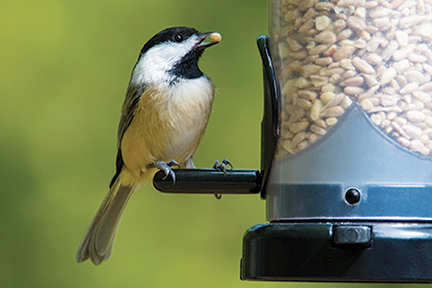
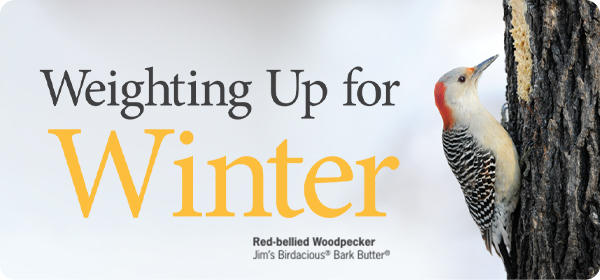
Over the eons, many of our winter birds learned to glean the trees in search of this frozen food supply that is high in the fats and protein they need to survive. It’s a behavior you have probably observed as you watched nuthatches, chickadees, kinglets, wrens and Brown Creepers explore every nook and cranny in the trees around your yard.
Enter Wild Birds Unlimited founder, Jim Carpenter. More than 30 years ago, he observed this foraging activity and set out to create a new bird food in the hope of attracting Brown Creepers to the trees in his yard. Working in his own kitchen, it took him nearly two decades to perfect the recipe and bring to market what is now known as Jim’s Birdacious® Bark Butter®.
Jim created Bark Butter as a “spreadable” suet that could be applied directly to the trunk of trees…and it soon became clear that it was a natural magnet for tree gleaning birds. Brown Creepers were not the only birds that loved it. Amazingly, over the past decade it has been documented to attracted more than 150 species of birds to our backyards
Providing high-energy, high-fat Bark Butter is hard to beat, especially during the winter. It is a great way to embrace the changing seasons and provide your birds with the best foods for their shifting nutritional needs. If critters are an issue in your yard, try offering Hot Pepper Bark Butter foods. Birds love them - critters not so much!
Your birds will love it, and besides, you may also be giving a cute little frozen inchworm a welcome reprieve to defrost next spring.
October in your Central Illinois backyard
October brings a little bit of everything to Central Illinois backyards. Fall migration is still rolling along, so keep an eye out for Yellow-rumped Warblers flitting through the trees and White-throated Sparrows scratching through leaves beneath shrubs and feeders. As temperatures drop, the first Dark-eyed Juncos start arriving for the winter. Spotting one hopping around beneath your feeders is a pretty good sign that cooler days are officially settling in.
Meanwhile, familiar favorites like Northern Cardinals, Blue Jays, chickadees, nuthatches, woodpeckers, and American Goldfinches are busy taking advantage of autumn's natural bounty and your backyard feeders. Keep seed, suet, and fresh water available as birds prepare for colder weather. October is also a good time to clean feeders, check your setup, and stock up on the foods your backyard visitors will rely on as fall turns toward winter.
October Bird Food Sale!
October 7-25: Save 15% on all bird food!
Daily Savings Club Members receive an extra 5% off the sale price.
The sale includes Bird Seed, Suet, Bark Butter®, Nectar, Peanuts, Seed Cylinders, Bark Butter Bugs N Bits®, and Bark Butter Bits®. It's a great time to fill the pantry before the colder weather arrives.
See this month's specials for all the details.
The Perfect Gift for Every Nature Lover
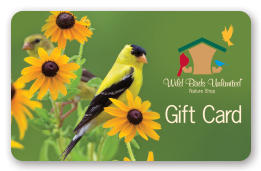
Every nature lover is different, so finding the ideal gift for them can be difficult. That's why our gift cards are the perfect gift for every occasion. They allow your friend or loved one to choose what part of nature he or she wants to enjoy. The best part: our gift cards are redeemable at every Wild Birds Unlimited location.